TL;DR
- 86% of organizations say they're not ready to adopt AI in day-to-day operations. That's the starting point, not a reason to wait.
- AI-native operations is a structural rebuild, not a software purchase. It has 7 phases and a defined sequence.
- Timelines differ by size: solopreneurs (~3 months), small businesses 2-50 employees (~6 months), medium businesses 51-500 (~12 months).
- Change management isn't a phase. It runs through everything. Skip it and your employees won't use what you built.
Why most AI projects fail before they start
Gartner predicts that through 2026, organizations will abandon 60% of AI projects for one reason: the data wasn't ready. Not because the model was wrong. Not because the use case was bad. The foundation wasn't there.
86% of leaders say their organizations aren't prepared to adopt AI in day-to-day operations. One in six have no one clearly in charge of it. And only 29% of companies under $100M in revenue have reached the AI scaling phase, compared to nearly half of large enterprises.
The pattern is predictable if you've seen it up close. Most businesses treat AI adoption as a procurement decision. Find a tool, buy a subscription, wonder why adoption is low six months later. The problem was never the tool. It was what was underneath it.
What AI-native actually means
"AI-native" gets used loosely. Here's what I mean by it: your operations are designed around AI from the start, not patched onto existing workflows after the fact.
McKinsey's research on the highest-performing AI companies is consistent on this point: they treat AI as a catalyst to redesign workflows, not a way to automate what already exists. That's the structural difference.
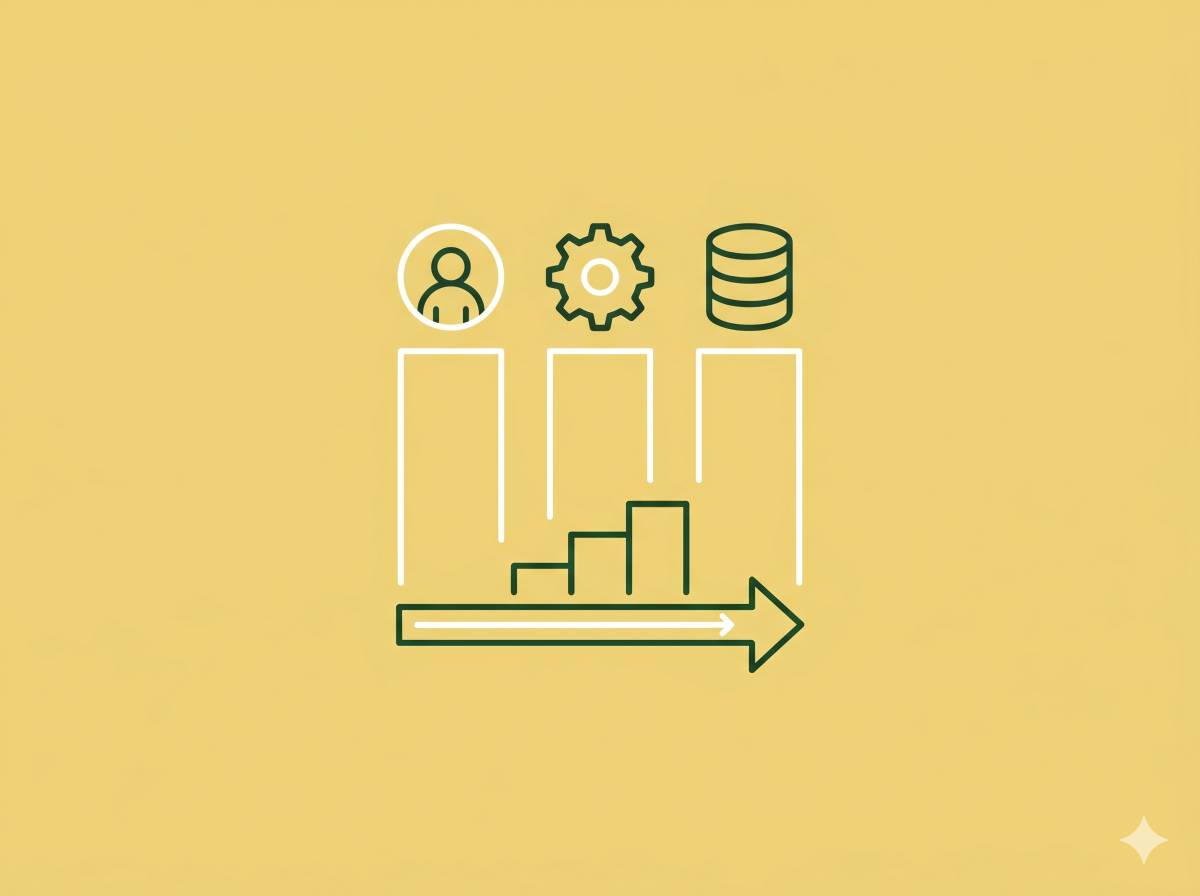
And it starts before any technology. It starts with an assessment - interviewing decision makers, talking to the people who actually run the work, mapping what's happening vs. what's supposed to happen. Three pillars get evaluated:
- People. Who does what. What they're worried about. Where they're stuck. Where they're covering for broken processes.
- Processes. What actually runs the business day to day. What's manual. What's duplicated. What shouldn't exist at all.
- Technology + data. What tools are in use, where data lives, how clean it is, how accessible it is.
That assessment is the input to everything that follows.
The 7-phase roadmap
Phase 1: Strategy. Assessment findings get synthesized into a plan across three layers - business, product, and technology. What are we actually trying to achieve? Which workflows matter most? What does success look like in numbers?
Phase 2: System Design. Strategic conclusions become architecture. What does the AI-native operating system look like for this specific business? What are the technical requirements? This isn't abstract architecture - it's the blueprint everything else is built from.
Phase 3: Workflow Design. Designing the actual operational workflows. Worth pausing on what a workflow means in practice: it's a repeatable business task with a clear start, inputs, outputs, and steps. Take image generation at a creative agency. That's a workflow. It probably has two modes - create (brief in, first draft out) and edit (existing asset in, revised version out). Each mode has different inputs, different quality checks, different approval steps. Once that's mapped, it can be designed properly, measured, and eventually automated. Every agency has 10-20 workflows like this. The design phase surfaces them, structures them, and makes them ready to build. The workflows have to match how the business actually runs, not how a consultant thinks it should. The people using these workflows need to be part of designing them. More on that shortly.
Phase 4: Data & Infrastructure. For solopreneurs and small teams, this is manageable. For medium businesses, this is often where the project hits its hardest wall. Data needs to be cloud-based, centralized, and clean before anything gets built on top of it. That Gartner number isn't a warning - it's a description of what happens when this phase gets skipped.
Phase 5: Iterative Build. Workflows get implemented one at a time, each with a defined outcome and a measurement plan. The goal isn't to ship everything at once - it's to prove value at each step before moving to the next.
Phase 6: Hardening & Go Live. Once all workflows have been built iteratively, there's a final round of cross-system refinement before full production. This is where edge cases surface. The system needs to run reliably - 24 hours, with minimal interruptions.
Phase 7: Monitor & Maintain. AI systems don't stay static. Providers update models. Business conditions change. Workflows that worked in month one may need adjusting in month six. Monitoring isn't an afterthought - it's what keeps the system delivering the business value it was built for.
The thread nobody talks about
Here's what gets dropped in most AI transformation plans: how your employees actually feel about it.
46% of employees cite concerns about AI as a top barrier to adoption - specifically fears around job threat, bias, and losing control of their work. And when companies overlook change management, middle managers start viewing AI as a threat rather than a tool. That resistance doesn't stay quiet. It slows adoption, kills buy-in, and eventually kills the project.
Business owners usually assume their teams are on board. They're often wrong.
I come from the product world. The rule there is simple: the people using what you build have to be at the center of how you build it. That principle doesn't change when the product is an internal AI system.
When I interview employees during the assessment phase, it's not just due diligence. It's the start of a trust relationship. Employees who weren't consulted during design will find ways to route around what gets deployed. Not out of stubbornness - out of skepticism that's entirely reasonable when no one asked their opinion.
Change management isn't a phase at the end of the roadmap. It's a thread that runs through every step - from who you interview at the start, to how workflows are explained and piloted, to how the system evolves over time.
How long does this actually take?
The honest answer is: it depends on your size.
Solopreneurs: About 3 months, end to end. Fewer stakeholders, simpler workflows, data is usually less fragmented. The main work is design and build.
Small businesses (2-50 employees): About 6 months. More workflows to map, more people to bring along, infrastructure work increases. Change management starts to matter here.
Medium businesses (51-500 employees): About 12 months, sometimes more. Data and infrastructure alone can take months to get to a state that supports AI. Change management becomes a significant workload in itself. Complexity compounds quickly at this scale.
These aren't conservative estimates padded for safety. They're what it actually takes to build something that runs reliably and delivers measurable ROI - not just a pilot that impresses in a demo and gets abandoned three months later.
One more thing
Most engagements end when the build phase ends. Mine often don't.
For the right projects, I commit to staying until the agreed business metrics have been met. Whether that's one month past go-live or three, I'll be there - measuring, iterating, refining - until the numbers say it's working.
That's not typical practice. But it's the only way I know how to do work I'm proud of.
If you're a founder or ops lead trying to figure out whether your business is actually ready for this - or whether the tool stack you're running is quietly working against you - feel free to reach out. No pitch, just a real conversation about where you are and what the path forward looks like.