TL;DR
- A fully loaded SDR costs $98K-$173K/year, takes 3+ months to ramp, and turns over at ~40% annually
- AI SDRs cost a fraction and work around the clock, but can't build genuine relationships or navigate complex objections alone
- McKinsey estimates 30%+ of sales tasks are automatable, and companies doing it well see up to 20% revenue gains
- The answer isn't AI OR human. It's AI for the mechanical work, human for the judgment calls. 68 leads managed, 7 meetings booked.
The Spreadsheet Case
If you're evaluating whether to hire an SDR or adopt an AI alternative, the cost comparison looks straightforward.
Hiring a human SDR:
- Base salary: $55K-$70K. On-target earnings: $80K-$85K.
- Add benefits, tools, management overhead, and office space: you're at $98K-$173K/year fully loaded.
- Ramp time: 3+ months before they're fully productive.
- Average tenure: 16 months. Annual turnover: roughly 40%.
- Each departure costs $115K-$195K when you factor in recruiting, training, and lost pipeline.
Using an AI SDR:
- Monthly subscription or managed service: a few hundred to a few thousand per month.
- No ramp time. No turnover. No sick days. No quota negotiation.
- Available 24/7 across every timezone.
On a spreadsheet, this isn't close. The AI wins by a wide margin.
But if spreadsheets were the whole story, every company would have already switched. They haven't. Here's why.
Where AI Actually Wins
Let's be specific about what AI does better. Not in theory, but in practice.
Speed. When a lead fills out a form at 11 PM, the AI responds in minutes. McKinsey's research shows that automation leaders boost revenue by as much as 20%, and speed-to-lead is a major driver.
Consistency. A human SDR has great days and bad days. The AI sends the same quality outreach on Friday afternoon as Monday morning. No motivation dips, no post-lunch slumps, no bad-meeting hangover. And unlike a time-strapped founder who never follows up at all — 48% of salespeople don't — the AI follows up every time, on schedule, because it doesn't have a client deliverable competing for its attention.
Scale without proportional cost. Adding 50 leads to a human SDR's pipeline means slower response times or a second hire. Adding 50 leads to an AI's pipeline means a slightly higher invoice.
Data processing. Research, enrichment, qualification scoring across dozens of signals. Humans can do it, but it takes hours per lead. AI does it in seconds.
Where Humans Still Win
Now the honest part that AI SDR vendors bury in their marketing.
Relationship nuance. When a prospect says "we're not looking right now," a skilled SDR hears the subtext: is this a real objection or a timing issue? Are they protecting budget or genuinely satisfied? Gartner predicts that by 2030, 75% of B2B buyers will still prefer sales experiences that prioritize human interaction. Buyers want to talk to people when the stakes are high.
Complex objections. "Your competitor offered us X." "We had a bad experience with a similar vendor." "Our board needs to see Y before approving." These require real-time judgment, empathy, and strategic thinking that AI can't reliably deliver today.
Organizational navigation. Multi-stakeholder deals, internal politics, reading a room during a call. A human SDR who's done 500 discovery calls develops instincts that no model replicates.
Trust formation. The shared context, the "I've been in your shoes" moment, the follow-up that references something from a conversation two weeks ago with genuine understanding. For relationship-driven businesses, this is where deals are won.
The Question Most Comparisons Get Wrong
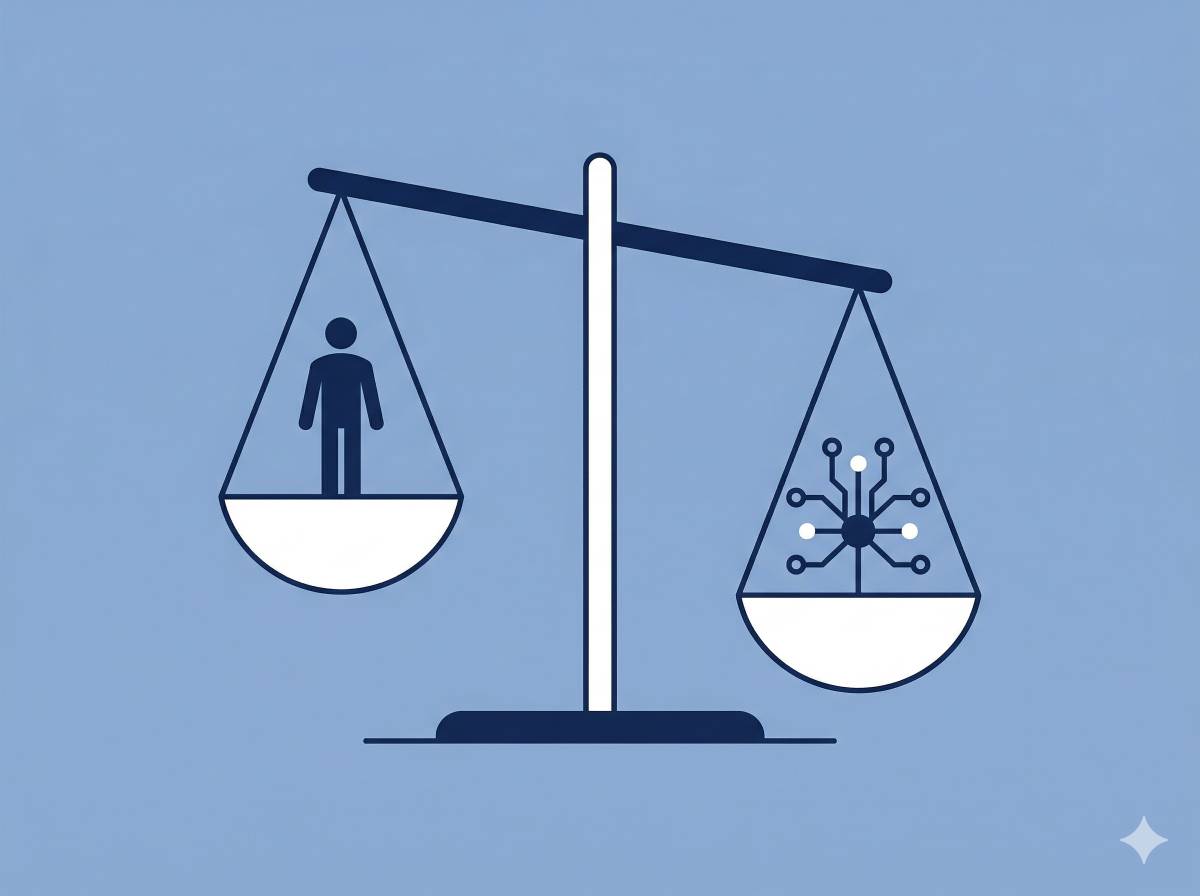
Most "AI vs. Human SDR" articles frame it as a replacement decision. Hire one or buy the other.
That framing misses the point.
Gartner expects AI agents to outnumber human sellers 10x by 2028, yet fewer than 40% of sellers will report that AI agents improved productivity. More AI doesn't automatically mean better results.
The real question is: which tasks belong to which?
Research, enrichment, first-draft outreach, follow-up cadence, scheduling coordination. These are mechanical. They're the reason your human SDR (or you, if you're the one selling) spends hours on work that never lands in a meeting room.
Objection handling, relationship building, strategic positioning, reading buyer intent. These are judgment calls. They're where human skill compounds over time and where trust is built.
The answer isn't AI replacing humans. It's AI handling the 70% that's mechanical so humans can focus on the 30% that closes deals.
What This Looks Like in Practice
We run a managed AI SDR at Think & Co. Here's what the hybrid model looks like with real numbers:
- 68 leads under active management
- 7 meetings booked
- ~28 leads qualified across multiple conversation turns
- Multi-language operation running in Hebrew and English
The AI handles research, enrichment, personalized drafting, follow-up scheduling, and calendar coordination. Every message goes out in the manager's voice — during onboarding, the manager gives detailed feedback on real drafts, and the agent earns autonomy on routine outreach within that session. Complex situations — objections, low sentiment, sensitive leads — always escalate to the human.
No one got a generic template. No one got a message that sounded like it came from a bot. And the manager who oversees this pipeline didn't spend hours writing first drafts or chasing scheduling logistics.
The Honest Recommendation
If you're a founder, consultant, or executive who sells alongside your core work, here's the straightforward take:
Don't hire a full-time SDR if your volume doesn't justify $100K+/year and 3 months of ramp time, or if you can't absorb the risk of 40% turnover resetting your pipeline.
Don't use a fully autonomous AI SDR if your business depends on relationships and your reputation is your pipeline. 73% of B2B buyers avoid suppliers who send irrelevant outreach. One bad AI-generated email to a warm referral can undo years of trust.
Do use an AI SDR with human oversight if you want the cost and speed advantages of AI without giving up control of your voice, your judgment, and your relationships.
The best version of this isn't a tool you configure once and forget. It's a system that learns your voice, earns your trust, and keeps you in control of the decisions that matter.