TL;DR
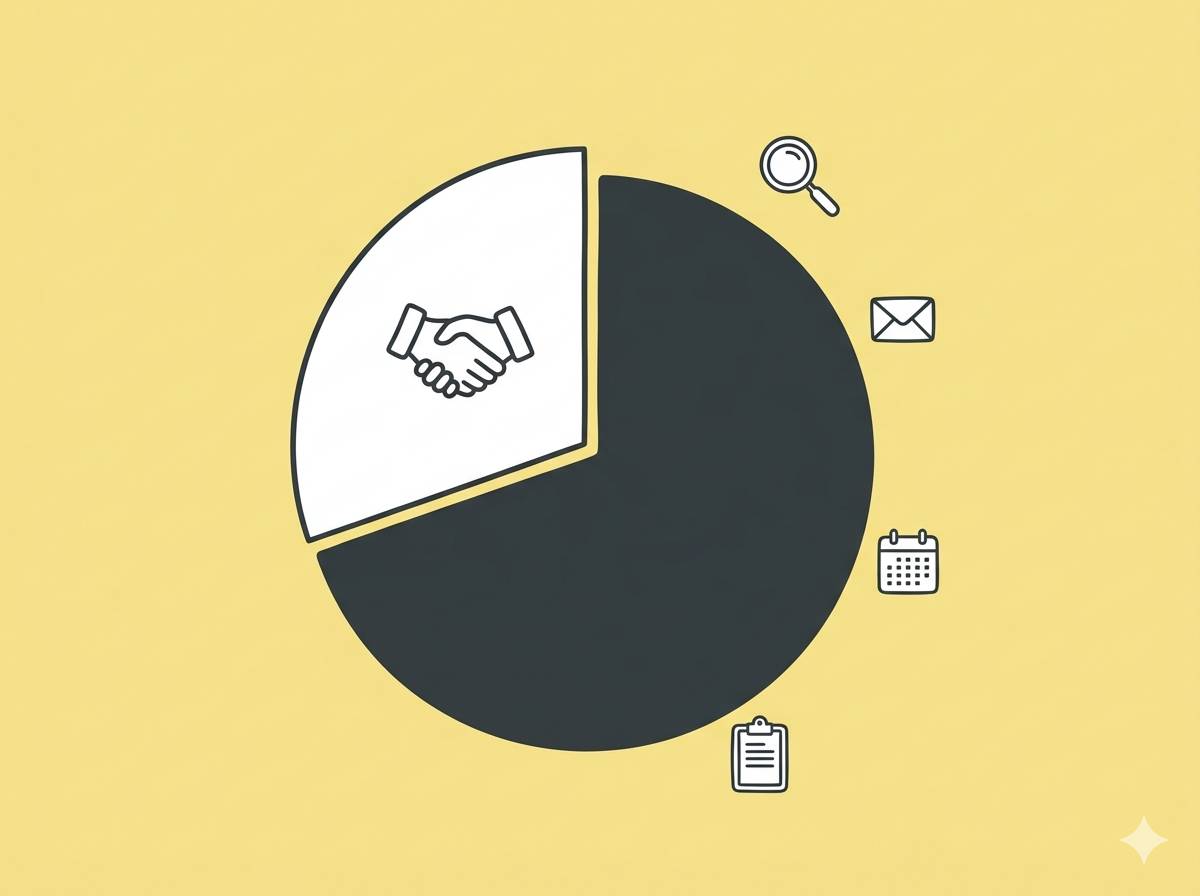
- Professionals who sell alongside their core work spend roughly 70% of their "selling" time on research, writing, follow-ups, and scheduling
- High-performing sales reps spend 20-25% more time with customers than lower performers. The gap isn't skill. It's how much non-selling work gets in the way
- For part-time sellers, the cost compounds: every hour on outreach is an hour not spent on billable work
- The answer isn't working harder or buying another tool. It's eliminating the busywork that shouldn't require you in the first place
The Time You Think You're Selling
You blocked off Tuesday afternoon for business development. Three hours, protected on your calendar. You're going to work your pipeline.
Here's what actually happens: You spend 40 minutes researching a prospect you met at an event last week. You draft a personalized email, revise it twice, send it. You check LinkedIn for two more leads a colleague mentioned. One has a sparse profile, so you search their company website for context. You draft another message. You realize you forgot to follow up with someone from two weeks ago, so you dig through your inbox, find the thread, write a follow-up. You check your calendar to propose times for a call. You update your tracking spreadsheet.
Three hours gone. Messages sent: two. Follow-ups: one.
That's the 70% problem. Research consistently shows that sales professionals spend the majority of their time on activities that aren't actually selling: research, writing, scheduling, and admin work. The highest-performing reps differentiate themselves not through better pitches, but by spending 20-25% more time in front of customers.
For a full-time seller, that's a productivity drag. For a founder, consultant, or executive who sells part-time, it's a structural trap.
The Part-Time Seller's Double Tax
Full-time SDRs at least have one job. Their entire role is moving leads through a pipeline. When admin eats their time, the only cost is slower pipeline velocity.
You pay twice.
Every hour you spend researching a prospect, drafting an email, or coordinating a meeting time is an hour you're not spending on the work that actually generates revenue: the client deliverable, the strategy session, the product decision. Your selling time doesn't just compete with admin. It competes with your core work.
This creates a pattern that's hard to break. You sell when you have capacity, which means you sell inconsistently. Leads go cold. Follow-ups slip. Prospects who were warm last week don't hear from you for ten days because you had a client deadline. By the time you circle back, they've moved on or forgotten the conversation.
73% of B2B buyers actively avoid suppliers who send irrelevant or poorly timed outreach. And "poorly timed" doesn't just mean spam. It means the follow-up that arrived two weeks late because you were buried in delivery.
Why "Just Hire Someone" Doesn't Solve It
The obvious answer is to hire an SDR. And for companies at a certain scale, that's the right call.
But for a 5-person consulting firm, a solo founder, or a small professional services team, the math doesn't work. A competent SDR costs $50,000-$70,000 per year fully loaded. That's before training, management overhead, and the ramp time before they understand your voice, your market, and your relationships well enough to represent you credibly.
There's also a subtler problem. In relationship-driven businesses, the prospect often wants to hear from you, not a generic SDR. Gartner predicts that by 2030, 75% of B2B buyers will prefer sales experiences that prioritize human interaction over AI. The relationship-driven market is moving toward more personal engagement, not less. Your outreach needs to sound like you because, for your buyers, that's the point.
Hiring someone to send messages on your behalf only works if those messages genuinely feel like they came from you. Most outsourced prospecting fails this test.
The Real Cost Is Invisible
The 70% problem doesn't show up on a P&L. It shows up in missed follow-ups, stale pipelines, and the deals that never started because you didn't have time to reach out.
Consider the compounding effect:
- Monday: You meet a promising prospect at an event. You plan to send a personalized note tomorrow.
- Tuesday-Thursday: Client work takes over. The note doesn't get written.
- Friday: You draft the note, but it's been four days. The moment has cooled.
- Next week: You send it. They respond politely but with less energy. You propose a call, but scheduling takes three more emails.
- Three weeks later: The meeting happens, but the initial warmth is gone.
Now multiply that across every lead, every month. McKinsey's research on AI agents in sales found that nearly eight in ten organizations report no significant bottom-line gains from their AI investments, largely because they automate fragments rather than rethinking the workflow end to end. The problem isn't a lack of tools. It's that the tools address symptoms while the structural issue persists: the person who should be in the meeting is stuck doing the work that leads to the meeting.
The Question Worth Asking
Here's what the 70% problem really comes down to: Which parts of your sales process actually need you?
The meeting itself? Absolutely. The relationship judgment? Yes. The decision about who to pursue and what to say? That requires your expertise.
But the research? The first draft? The follow-up timing? The scheduling back-and-forth? Those are mechanical steps that follow patterns. Your patterns, but patterns nonetheless.
Gartner predicts that by 2028, AI agents will outnumber sellers by 10x. But fewer than 40% of sellers expect those agents to actually improve productivity. The gap between availability and impact is real.
The professionals who will close that gap aren't the ones who adopt the most tools. They're the ones who correctly identify which 70% of their process can be handled without them, and find a way to offload it without sacrificing the quality and voice that makes their outreach work.
That's a solvable problem. And solving it doesn't mean working harder or adding another tool to your stack. It means rethinking which parts of selling actually require the seller.